
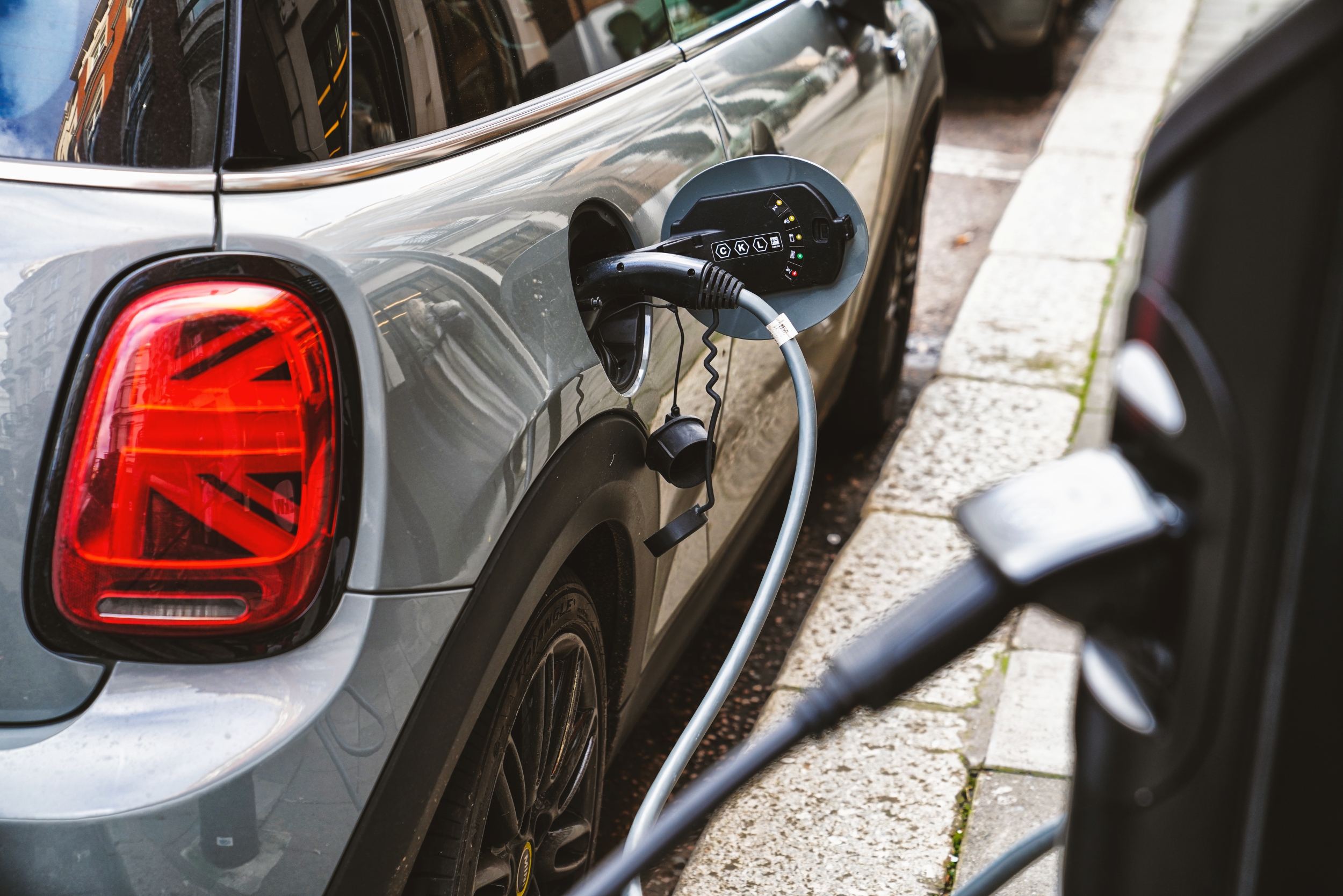
March is here and, again, the race for market share is on – with new registrations led by electric vehicles (EVs). Déjà vu.
Last year, we saw this EV push start in early Feb ’25. This year, our market tracker shows it kicked in at the end of Feb ’26. New Year “sales” activity focused on ICE, but EV rates dropped sharply in the last week of Feb and have since outpaced ICE rate reductions versus the start of the year.
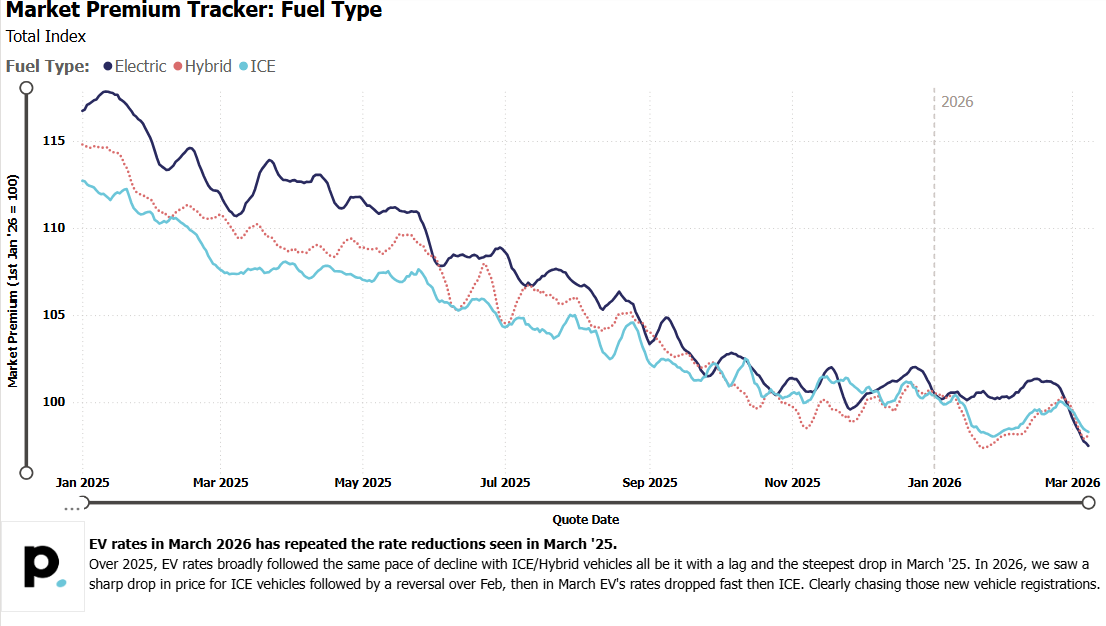
We were delighted to contribute to the IFoA EV Working Party for GIRO ’25, after Andy Goldby reached out. We focused on the relative price movement of EV vs ICE. Our Tracker showed EV relative price changes broadly in line with ICE; the Working Party showed that absolute EV prices remain significantly higher than ICE. That leaves two possibilities: ICE is underpriced relative to EV, or EV is overpriced and will need to fall faster than ICE to reach parity – all else being equal (which, of course, it never is).
We see three reasons why EV pricing (or burn cost) could reach, or even beat, ICE over time:
1. An emerging segment versus an ageing ICE parc
EVs represented 20%+ of new car registrations in 2025, but still only around 4% of the UK car parc (SMMT). With small volumes, experience is volatile and EVs look riskier than ICE.
At the same time, the average UK car is now nearly 10 years old (RAC, Aug ’25). Many owners are due to replace ageing, non‑(U)LEZ‑compliant vehicles, which could accelerate EV share of the parc.
Pricing models, however sophisticated, are still constrained by the data each firm sees. As pricing structures become more complex, it becomes harder to see where models are extrapolating into thin EV experience versus where judgement is needed. This should improve as the segment grows, but in the near term it leaves room for specialist EV MGAs to seize share.
2. Better technology and safety → lower frequency
EVs come loaded with safety features (for example, no front engine allows a longer crumple zone and can reduce injury severity), are simpler to drive (one‑pedal driving, no gears), and often have lower top speeds. Once drivers adjust to the different acceleration profile, EVs can be very easy to drive.
There is also a selection effect: the EV Working Party showed that nearly two‑thirds of EV drivers are over 30 and typically in higher socio‑economic groups. All of this should support lower claim frequency, yet many pricing models still extrapolate primarily from ICE experience. That raises the question: are you adjusting your models and inputs to reflect where risk is heading, not just where it has been?
3. A maturing repair and resale ecosystem
The main rationale for higher EV premiums today is repair cost. High‑voltage batteries and dense sensor suites are expensive to replace, and many local garages still cannot work on EVs, pushing repairs back to manufacturers or specialist centres.
EVs also tend to depreciate faster than ICE (with exceptions for some premium models such as the Porsche Taycan or Mercedes EQC), which increases the share of high‑ticket total loss claims. From that angle, it is not surprising that absolute EV prices are higher.
But as demand grows, the supply chain will adapt: more repair capacity, more parts availability, and lower average repair costs. As technology and battery performance stabilise, residual values should improve, just as we saw with smartphones once the innovation curve flattened. Over time, many of today’s “EVs are expensive to fix” arguments will weaken.
These forces will not transform EV pricing overnight. But if pricing models are meant to be forward‑looking rather than over‑fitted to the past, they need to anticipate where EV risk and cost are going – not just defend where they are today.
An innovative insurer, broker or MGA could use this window to build a profitable EV book and a back‑book that funds future growth as EV penetration in the parc ramps. The EV Working Party estimates a 50:50 EV–ICE split in around 10 years; with an ageing parc and supportive policy, that shift could come faster than many expect.